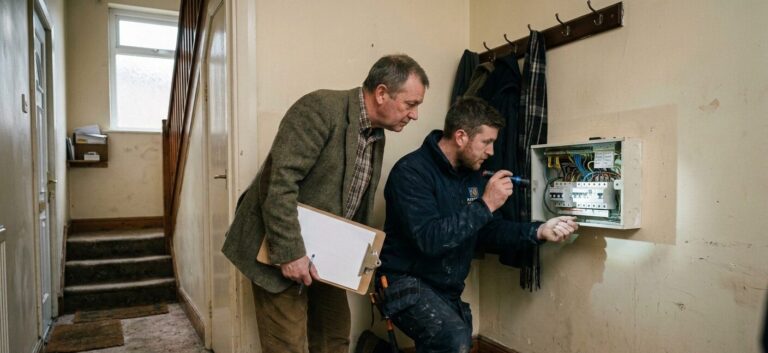

The Private Tenancies Act (Northern Ireland) 2022 is the most significant reform of the private rented sector in Northern Ireland for a generation. Passed by the Assembly in May 2022, it has been implemented in phases — each phase bringing new obligations for landlords and letting agents. Some of those phases are now law and being actively enforced. Others are still being developed.
This guide covers the complete implementation timeline: what has already come into force, what the obligations are in practical terms, what the penalties are for non-compliance, and what is still to come from the Assembly’s ongoing rental reform debate. It is the definitive reference document for every landlord and letting agent operating in Northern Ireland in 2026.
| WHO IS RESPONSIBLE FOR COMPLIANCE?
In Northern Ireland, the Department for Communities is responsible for private tenancies legislation. The courts administer it. Local councils enforce it — including issuing fixed penalty notices for breaches. Landlords are ultimately responsible for compliance, even where a letting agent is acting on their behalf. A letting agent’s failure to act does not transfer or reduce the landlord’s legal liability. |
The Private Tenancies Act 2022: Complete Implementation Timeline
The Act was introduced gradually, with different sections commencing at different dates. Here is the full chronology from Royal Assent to the current position.
| Date | What Came Into Force | Section / Regulation |
|---|---|---|
| 28 April 2022 | Royal Assent — Act passed by the Northern Ireland Assembly | Private Tenancies Act (NI) 2022 |
| 5 May 2022 | Changes to notice to quit periods — initial commencement | Section 14(2) |
| 1 April 2023 | Sections 1–6 in force: Tenancy Information Notices, deposit cap (1 month’s rent), cash receipt requirements, deposit protection as continuing offence | SR 2023/20 |
| 30 May 2024 | Section 8 Regulations made: Smoke, Heat and CO Alarm standards | NISR 2024/123 |
| 1 September 2024 | Alarm regulations in force for all new tenancies granted from this date | NISR 2024/123, Reg 1(2)(a) |
| 1 December 2024 | Alarm regulations apply to all existing private tenancies — full compliance required | NISR 2024/123, Reg 1(2)(b) |
| 1 April 2025 | EICR mandatory for all new private tenancies from this date | Electrical Safety Regulations (NI) |
| 1 December 2025 | EICR mandatory for all existing private tenancies — deadline passed | Electrical Safety Regulations (NI) |
| 2026 onwards | Assembly rental reform debate ongoing — People’s Housing Bill, notice period regulations, energy efficiency standards under consultation. No radical changes yet law. | Department for Communities |
Sections 1–6: In Force Since 1 April 2023
The first substantive phase of the Act came into force on 1 April 2023. These sections introduced a suite of new obligations around tenancy documentation, deposits and payments that apply to every private tenancy in Northern Ireland.
| SECTION 1–2: Tenancy Information Notice | In force: 1 April 2023 | ✓ NOW LAW |
The most visible new obligation introduced by Sections 1–6 is the Tenancy Information Notice (TIN). Every landlord granting a private tenancy must provide the tenant with a free written notice within 28 days of the tenancy beginning.
| Q: What is a Tenancy Information Notice (TIN) in Northern Ireland?
A: A Tenancy Information Notice is a prescribed form, introduced by the Tenancy Information Regulations (Northern Ireland) 2023, that landlords must give to every tenant within 28 days of a new tenancy starting. The notice sets out the terms of the tenancy including the amount of rent payable, the landlord’s name and contact details, the address of the property, the duration of the tenancy, and the rights and responsibilities of both landlord and tenant. The Department for Communities has published official template forms. Failure to issue the notice is a criminal offence. |
| Q: Does the Tenancy Information Notice apply to existing tenancies?
A: Yes — on 1 April 2023, landlords were also required to issue retrospective notices to existing tenants whose tenancies were granted on or after 30 June 2011 and who had not previously received a notice containing the required information. Landlords who had already provided documentation substantially covering the required information were treated as compliant. The Notice of Variation form must be issued within 28 days whenever a prescribed term of the tenancy changes — for example, if the rent is varied. |
| OFFENCE: Failure to issue a Tenancy Information Notice
A landlord who fails to provide a Tenancy Information Notice within 28 days of the tenancy starting is guilty of a criminal offence under the Private Tenancies Act (NI) 2022. Local councils can issue fixed penalty notices. On conviction by a court, the penalty is a fine. The same applies to failure to issue a Notice of Variation when tenancy terms change. |
| SECTION 3–4: Deposit Cap and Protection | In force: 1 April 2023 | ✓ NOW LAW |
Sections 3–4 of the Act introduced two significant changes to tenancy deposit rules that apply to all private tenancies in Northern Ireland.
| Q: What is the tenancy deposit cap in Northern Ireland?
A: Since 1 April 2023, landlords in Northern Ireland cannot require a tenancy deposit exceeding one month’s rent. This cap applies at the point of granting the tenancy. Landlords or agents who require a deposit above this limit are guilty of an offence. Where a deposit was lawfully taken before 1 April 2023 at a higher level, the excess must be returned to the tenant. The cap applies regardless of any other arrangement agreed between landlord and tenant — it cannot be contracted out of. |
| Q: Has tenancy deposit protection changed under the Private Tenancies Act 2022?
A: Yes — the Act made the failure to protect a tenancy deposit a continuing offence and removed the previous 6-month time limit on prosecution. This means that even if a tenant only discovers at the end of their tenancy that their deposit was never protected in an approved scheme, the landlord can still be prosecuted — there is no statute of limitations protection for landlords who failed to comply. Northern Ireland’s approved deposit protection schemes (My Deposits NI, TDS NI and the Tenancy Deposit Scheme NI) must be used by landlords who hold deposits. |
| SECTION 5–6: Cash Receipts | In force: 1 April 2023 | ✓ NOW LAW |
| Q: Do I have to provide receipts for cash rent payments in Northern Ireland?
A: Yes — since 1 April 2023, landlords must provide a written receipt for any cash payment made by a tenant relating to a private tenancy, including rent payments and any other tenancy-related payments. The receipt must include the payment date, the amount paid, and how the amount is apportioned where it covers multiple obligations. The receipt must be provided at the time of payment. Failure to provide a receipt — or providing an incorrect receipt — is a criminal offence. This obligation is designed to provide tenants with a clear payment record and reduce disputes. |
Section 8: Smoke, Heat and Carbon Monoxide Alarms
| New tenancies: 1 September 2024 | All tenancies: 1 December 2024 | NISR 2024/123 | ✓ NOW LAW |
Section 8 of the Act introduced a duty on landlords to keep in repair and working order sufficient appliances for detecting fire, smoke and carbon monoxide. The Smoke, Heat and Carbon Monoxide Alarms for Private Tenancies Regulations (Northern Ireland) 2024 set the specific minimum standards. These regulations came into force for new tenancies on 1 September 2024 and applied to all existing tenancies by 1 December 2024.
All private rented properties in Northern Ireland are now required to comply. Non-compliance is a prosecutable offence with a maximum fine of £2,500.
Minimum Alarm Requirements
The regulations set the following minimum standards for every privately rented property in Northern Ireland:
| Alarm Type | Required Location(s) | Standard |
|---|---|---|
| Smoke alarm | The main living room (room most frequently used for daytime living) | British Standard BS 5839-6 |
| Smoke alarm | Every circulation space on each storey — every hall, landing, corridor | British Standard BS 5839-6 |
| Heat alarm | Every kitchen | British Standard BS 5839-6 |
| Carbon monoxide alarm | Every room or circulation space containing a fixed combustion appliance or flue (excluding gas cookers) — including any bedroom a flue passes through | British Standard BS EN 50292 |
| INTERLINK REQUIREMENT
All smoke and heat alarms must be interlinked — either by wiring or by RadioLINK wireless technology — so that when one alarm activates, all alarms in the property sound. Carbon monoxide alarms do not need to be interlinked with smoke and heat alarms. |
| Q: Can I use battery-powered alarms to comply with the NI smoke and heat alarm regulations?
A: Yes — alarms can be mains wired, battery powered or a combination of both. However, battery-operated alarms must be sealed tamper-proof units with long-life batteries, compliant with current building regulation standards. Mains-wired alarms must be fitted by a qualified electrician registered with a recognised electrical trade body. All alarms — whether battery or mains — must meet the relevant British Standard (BS 5839-6 for smoke and heat; BS EN 50292 for carbon monoxide). |
| Q: What happens if a smoke, heat or CO alarm becomes faulty during the tenancy?
A: Landlords must repair or replace any alarm as soon as they are informed it has become faulty. The tenant’s responsibility is to test alarms regularly — the Department for Communities recommends weekly testing by pressing the test button — and to report any faults to the landlord or letting agent promptly. Tenants must not tamper with alarm units. Landlords should keep records of alarm installations, maintenance and any replacements, as this documentation may be required in the event of an enforcement inspection or prosecution. |
| Q: Who is responsible for alarm compliance — the landlord or the letting agent?
A: The landlord has ultimate legal responsibility for alarm compliance, even where a letting agent has been appointed to manage the property. A letting agent’s failure to act does not transfer or reduce the landlord’s liability. Propertymark (ARLA) recommends that letting agents take on the practical responsibility for ensuring compliance, even if they cannot bear the legal liability. Belvoir NI’s managed service includes alarm compliance checks as standard. |
Section 10: Electrical Installation Condition Reports (EICR)
| New tenancies: 1 April 2025 | All tenancies: 1 December 2025 | Electrical Safety Regulations (NI) | ✓ NOW LAW — DEADLINE PASSED |
Section 10 of the Private Tenancies Act 2022 required landlords to obtain Electrical Installation Condition Reports (EICRs) for their privately rented properties. The obligation was implemented in two stages: from 1 April 2025 for all new tenancies, and from 1 December 2025 for all existing tenancies.
The 1 December 2025 deadline has now passed. Every private tenancy in Northern Ireland should now have a valid EICR. For any managed landlord whose EICR was not in place before the deadline, Belvoir NI can arrange an inspection as a matter of priority.
| THE DECEMBER 2025 DEADLINE HAS PASSED — ARE YOU COMPLIANT?
The EICR deadline for all existing NI tenancies was 1 December 2025. If your property does not have a valid EICR — or if your EICR has expired — you are currently operating outside the law. The consequences include enforcement action by your local council, fixed penalty notices, and potential prosecution. If you are uncertain about your compliance position, contact Belvoir NI immediately. |
| Q: What is an EICR and what does it cover in Northern Ireland?
A: An Electrical Installation Condition Report (EICR) is an inspection and test of all fixed electrical cables and fixed electrical equipment on the consumer’s side of the electricity supply meter. It must be carried out by a qualified electrical professional — typically a registered electrician holding a recognised qualification in electrical testing and inspection. The report assesses whether the electrical installation is in a satisfactory condition for continued use, identifies any defects, deterioration or non-compliances, and recommends any remedial work required. The EICR is not a simple visual check — it involves physical testing of circuits and equipment. |
| Q: How long is an EICR valid for in Northern Ireland?
A: The regulations require an EICR to be obtained from a qualified professional before the start of any new tenancy from 1 April 2025, and before 1 December 2025 for all existing tenancies. The EICR report itself will recommend the interval for the next inspection — typically every 5 years for most domestic properties, or more frequently if defects are found. Landlords should retain the original EICR and be prepared to provide a copy to their local council enforcement officer on request. |
| Q: What if the EICR identifies remedial work is needed?
A: If an EICR inspection identifies defects classified as C1 (danger present — immediate action required) or C2 (potentially dangerous — urgent remedial work required), the landlord must arrange for the work to be completed promptly before or at the earliest opportunity after the tenancy commences. Further Improvement (FI) observations should be addressed within an agreed timeframe. A follow-up inspection may be required to confirm remedial works are complete. Landlords who fail to act on C1 or C2 findings are at significant legal and insurance risk. |
| Q: Can a tenant refuse access for an EICR inspection?
A: Landlords must take reasonable steps to arrange access for EICR inspections. If a tenant unreasonably refuses access, the landlord should document their attempts and seek legal advice. Landlords who can demonstrate they made genuine efforts to obtain access but were refused are in a different position to those who simply failed to arrange an inspection. Belvoir NI’s managed service includes access management and can assist with arranging and documenting inspection attempts. |
| EICR Finding Code | Meaning | Required Action |
|---|---|---|
| C1 | Danger present — risk of injury | Immediate remedial action required. Do not let the property until resolved. |
| C2 | Potentially dangerous | Urgent remedial work required as soon as practicable. |
| C3 | Improvement recommended | Not a compliance failure — landlord’s discretion, but advisable to act. |
| FI | Further investigation required | Cannot determine compliance without further investigation. Action required. |
| Satisfactory | No deficiencies found | EICR valid — note recommended re-inspection date (typically 5 years). |
What’s Still to Come: The Assembly’s Ongoing Agenda
The Private Tenancies Act 2022 explicitly anticipated further regulations on several matters that have not yet been fully implemented. The Department for Communities is also monitoring the broader Assembly debate on rental reform. Here is where things stand in 2026.
Notice to Quit Periods — Regulations Still Pending
The Act empowers the Department for Communities to make regulations establishing certain exceptions to notice to quit periods — for example, where a tenant is in rent arrears. A research paper into these exceptions was to be developed. Regulations have not yet been finalised. The existing notice period structure remains in place under the Private Tenancies (NI) Order 2006 pending new regulations.
| Q: What are the current notice to quit periods for Northern Ireland private tenancies?
A: Under the existing framework (modified by the Act’s initial commencement in May 2022), the minimum notice period a landlord must give a tenant depends on the length of the tenancy. For tenancies of less than 1 year: 4 weeks notice minimum. For tenancies of 1–10 years: 8 weeks minimum. For tenancies of 10 years or more: 12 weeks minimum. Tenants must give a minimum of 4 weeks notice regardless of tenancy length. These periods may be extended by future regulations. Landlords should always check the current position with a solicitor or Belvoir NI before serving notice. |
Rent Payment Methods — Regulations Still Pending
The Act includes a provision requiring landlords to give tenants a choice of payment methods for rent. A report on this provision was expected by October 2023. Regulations have not yet been introduced. Landlords are not currently required to offer multiple payment methods, though best practice is to do so.
Energy Efficiency Standards — Under Consultation
The Department for Communities is consulting on regulations concerning the energy efficiency of dwellings let under a private tenancy in Northern Ireland. No timeline has been confirmed for the introduction of minimum EPC standards in NI’s private rented sector. Landlords should monitor this development — it will likely introduce minimum energy efficiency requirements similar to those being pursued in England and Wales.
| FORWARD LOOK: Energy Efficiency Regulations
Northern Ireland does not yet have a minimum EPC standard for private rental properties. However, the Department for Communities has indicated this is under active consultation. Landlords with properties at EPC rating E or below should consider improvement works now — both to future-proof compliance and to reduce void risk as tenants increasingly prioritise energy costs. |
The Assembly Rental Reform Debate in 2026
Beyond the Private Tenancies Act 2022’s own programme of regulations, the Northern Ireland Assembly is conducting a broader debate about the future direction of the private rented sector. This is separate from the PTA 2022 implementation and involves proposals that are not yet law.
| IMPORTANT: Proposals ≠ Law
The Assembly reform proposals discussed below are live political debates — not enacted legislation. No radical changes to rent controls, no-fault eviction bans or mandatory licensing have yet become law in Northern Ireland. Landlords should focus compliance efforts on the obligations under the Private Tenancies Act 2022 (which is law) and monitor Assembly developments through Belvoir NI’s regulatory newsletter. |
| Q: What is the People’s Housing Bill in Northern Ireland?
A: The People’s Housing Bill is a Private Members’ Bill introduced in the Northern Ireland Assembly by MLA Gerry Carroll (People Before Profit). It proposes significant reforms to the private rented sector including rent controls, extended notice periods, a dedicated Rental Board, improved energy efficiency standards, and measures to bring vacant homes back into use. The Bill was debated in the Assembly and Carroll MLA submitted a final proposal to the Assembly Speaker. As of early 2026, the Bill has not been passed into law and the Assembly has not yet indicated it will do so. The Executive’s preferred approach has focused on housing supply rather than rent controls. |
| Q: Could rent controls be introduced in Northern Ireland?
A: The Private Tenancies Act (NI) 2022 does include a dormant power (Article 5C of the Private Tenancies (NI) Order 2006, inserted by Section 7 of the Act) enabling the Department for Communities to make regulations capping rents in defined areas. However, this power has not been exercised and the conditions for its activation (designation of rent control areas) have not been met. The current Housing Minister’s position has prioritised housing supply over rent controls, consistent with housing economics consensus that supply-side measures are more effective than price controls. As of February 2026, rent controls are not in force in Northern Ireland. Landlords should not confuse the Republic of Ireland’s rental reforms (which introduced national rent controls in March 2026) with Northern Ireland — these are entirely separate jurisdictions with different legislation. |
| Q: Will no-fault evictions be banned in Northern Ireland?
A: There is currently no legislation banning no-fault evictions in Northern Ireland. The People’s Housing Bill proposed significant restrictions. The Department for Communities has signalled it may consult on extended notice periods under the PTA 2022’s existing framework. However, as of early 2026, no-fault evictions remain lawful in Northern Ireland subject to the notice to quit periods under the Private Tenancies (NI) Order 2006. This contrasts with England, where the Renters’ Rights Act 2025 has introduced significant changes. Landlords should monitor Assembly developments — Belvoir NI tracks these closely and updates managed landlords when changes are confirmed. |
| Q: What is the letting fees situation in Northern Ireland?
A: In February 2025, a Private Members’ Bill was proposed by MLA Ciara Ferguson to ban letting fees charged by landlords and agents in Northern Ireland. As of early 2026, this Bill has not been enacted. Propertymark (ARLA) has engaged with the proposals and expressed concerns about the impact on agency viability and ultimately on landlord costs. The position contrasts with England, Scotland and Wales where letting fees from tenants are already banned. Belvoir NI will update managed clients if and when this becomes law. |
The 2026 NI Landlord Compliance Checklist
Use this checklist to audit your compliance position against every current obligation under the Private Tenancies Act (Northern Ireland) 2022 and associated regulations.
| Obligation | Since | Status Check |
|---|---|---|
| Tenancy Information Notice issued to each tenant within 28 days of tenancy start | 1 April 2023 | Do you have a signed acknowledgement or delivery record for every current tenancy? |
| Notice of Variation issued within 28 days of any change to prescribed tenancy terms | 1 April 2023 | Have all rent changes and term variations been notified via the correct form? |
| Tenancy deposit does not exceed one month’s rent | 1 April 2023 | Are all deposits held at or below one month’s rent? |
| Tenancy deposit protected in an approved NI scheme (MyDeposits NI, TDS NI, TDSNI) | Ongoing | Is every deposit protected and has prescribed information been issued to the tenant? |
| Written receipts issued for all cash payments at time of payment | 1 April 2023 | Is a cash receipt process in place for any tenants paying by cash? |
| Smoke alarm in main living room, every circulation space on each storey | 1 December 2024 | Has each property been inspected and fitted to comply? |
| Heat alarm in every kitchen | 1 December 2024 | Are heat alarms installed in all kitchens across all properties? |
| CO alarm in every room/circulation space with a fixed combustion appliance or flue | 1 December 2024 | Are CO alarms installed in all applicable rooms? |
| All smoke and heat alarms interlinked (wired or RadioLINK) | 1 December 2024 | Have all alarms been confirmed to interlink correctly? |
| All alarms meet British Standards (BS 5839-6 smoke/heat; BS EN 50292 CO) | 1 December 2024 | Do all installed alarms carry the correct British Standard certification? |
| Valid EICR obtained for all tenancies | 1 December 2025 | Does every property have a current EICR issued by a qualified inspector? |
| Any C1 or C2 EICR findings remediated | 1 December 2025 | Has all required remedial electrical work been completed and documented? |
| BELVOIR NI MANAGED LANDLORDS
If Belvoir Northern Ireland manages your property, your compliance across all of the above obligations is actively monitored as part of your management service. Belvoir NI coordinates EICR inspections, alarm compliance checks, Tenancy Information Notice issuance and deposit protection as standard. If you are self-managing and uncertain about any of the above, contact your nearest Belvoir NI office for a free compliance audit. |
Private Tenancies Act NI 2022: Quick Reference Q&A
| Q: Does the Private Tenancies Act 2022 apply to all private tenancies in Northern Ireland?
A: Yes — the Act applies to all private tenancies in Northern Ireland, including assured shorthold tenancies, periodic tenancies and fixed-term agreements. It applies to individual landlords, companies and any person granting a private tenancy of a dwelling-house. It does not apply to social tenancies (Housing Executive or housing association) or to tenancies that are excluded from the Private Tenancies (NI) Order 2006 framework. |
| Q: Who enforces the Private Tenancies Act in Northern Ireland?
A: Local councils (the 11 district councils) are responsible for enforcing the Private Tenancies Act in Northern Ireland. They can issue fixed penalty notices for specific offences — including failure to issue a Tenancy Information Notice, failure to comply with the alarm regulations, and breach of the deposit cap. The courts handle prosecution for more serious offences. The Department for Communities oversees the legislative framework but does not directly investigate individual complaints — these should be directed to the relevant local council. |
| Q: What are the penalties for non-compliance with the Private Tenancies Act NI 2022?
A: Penalties vary by offence. Failure to issue a Tenancy Information Notice or Notice of Variation: criminal offence, subject to fixed penalty notice or court fine. Breach of the deposit cap (requiring more than one month’s rent): criminal offence. Failure to comply with smoke, heat and CO alarm regulations: prosecutable offence, maximum fine £2,500. Failure to comply with EICR obligations: enforcement action by local council. In all cases, landlords also face civil claims from tenants and potential difficulties in serving valid notices to quit or relying on tenancy documentation in court proceedings. |
| Q: I am a new landlord in Northern Ireland. What do I need to do immediately?
A: Before granting your first tenancy: ensure your property has a valid EICR; confirm smoke, heat and CO alarms are installed and compliant with NISR 2024/123 (British Standard certified, interlinked where required); register the tenancy deposit in an approved NI scheme within the required timeframe; and issue a Tenancy Information Notice to your tenant within 28 days of the tenancy start using the Department for Communities’ prescribed form. If you appoint a managing agent, ensure they operate to ARLA Propertymark standards and can evidence compliance management on your behalf. Belvoir NI is ARLA Propertymark Protected and manages all of the above as part of our standard service. |
| Q: Does Northern Ireland have its own landlord registration scheme?
A: Northern Ireland operates landlord registration through the NIHE (Northern Ireland Housing Executive) Landlord Registration Scheme, which is separate from and operates differently to schemes in Scotland (Landlord Register) and Wales (Rent Smart Wales). Registration requirements and NIHE enforcement capacity continue to develop alongside the PTA 2022 implementation programme. Belvoir NI can advise on current registration requirements applicable to your property. |
| Book a Free PTA 2022 Compliance Audit with Belvoir Northern Ireland
Not sure where your compliance stands? Belvoir NI offers a free landlord compliance review covering every obligation under the Private Tenancies Act 2022 — EICR status, alarm compliance, Tenancy Information Notices, deposit protection and more. Our specialists know this legislation in depth and can identify any gaps before your local council does. → Contact your nearest Belvoir Northern Ireland office to book your free compliance audit |
Belvoir Northern Ireland | belvoir.co.uk/northern-ireland
Belvoir Group — UK’s Largest Property Franchise | ARLA Propertymark Protected | Client Money Protection | Registered with NIHE Landlord Register
Information correct as of February 2026. Legislative references: Private Tenancies Act (Northern Ireland) 2022 (c.20 NIA); SR 2023/20; NISR 2024/123; Electrical Safety Regulations (NI) 2025. Assembly reform proposals are subject to change — Belvoir NI monitors and updates this guide when legislation changes. This guide is for general information only and does not constitute legal advice. Always seek specialist legal advice for specific compliance questions.