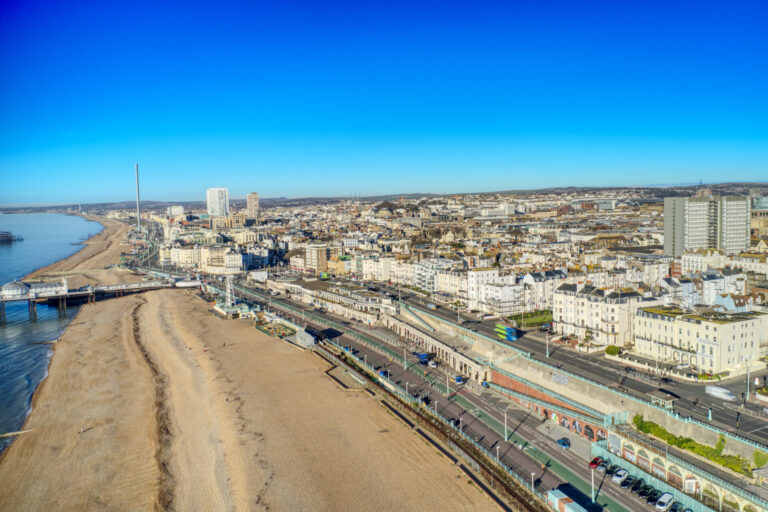

Brighton has always been a city of contrasts — and nowhere is that more visible than in its property market. On one side, you have the sweeping Regency crescents of Brunswick Town, the ornate Victorian terraces of the Avenues in Hove, and the colourful bay-fronted homes of Cliftonville. On the other, a new wave of contemporary new-build developments is reshaping areas like New England Quarter and Moulsecoomb.
For buyers and sellers weighing up their options in 2026, the question is no longer simply about aesthetics. It is about speed of sale, achieved prices, and long-term capital strength. So which property type is winning right now in Brighton — and what does that mean for your next move?
The Brighton property market in 2026: Setting the scene
Brighton and Hove remains one of the most resilient property markets in the South East. Average property prices across BN1, BN2, and BN3 postcodes have held firm despite wider national pressures, with buyer demand continuing to outpace available stock in many pockets of the city.
According to Rightmove’s 2025/2026 market data, Brighton and Hove properties are achieving an average of around 98–99% of their asking price, reflecting strong buyer competition. Time-to-sale figures vary considerably, however, depending on property type — and that is exactly where the new build vs period debate becomes critical.
How period properties perform in Brighton’s key postcodes
Period homes — broadly defined as pre-1919 Regency, Georgian, and Victorian stock — dominate Brighton’s most desirable streets and continue to command significant buyer interest.
BN1: The heart of period Brighton
In BN1, covering central Brighton and areas like Hanover and Prestonville, Victorian terraces and Regency-era properties remain perennially popular. Streets such as Elm Grove, Roundhill Crescent and the terraces surrounding the Level attract buyers who value character, community feel, and proximity to the city centre.
Period homes in BN1 typically sell within 45 to 65 days of listing, based on current market indicators. Demand is consistently strong among young professionals, families, and second-home buyers drawn to the city’s cultural energy.
BN3: Hove’s Avenues and Brunswick Town
Hove’s BN3 postcode is arguably Brighton and Hove’s most prestigious address for period buyers. The Avenues — covering streets like The Drive, Cromwell Road, and Wilbury Road — offer some of the finest Edwardian and late Victorian housing stock in the South East.
Brunswick Town, with its Grade I and II listed Regency terraces, attracts a discerning buyer profile willing to invest in restoration and long-term capital appreciation. These properties often achieve above asking price in competitive scenarios, though their time-to-sale can extend to 60–80 days due to the specialist buyer pool and conveyancing complexity around listed buildings.
BN2: Cliftonville’s and Kemptown’s period appeal
In BN2, period properties in Cliftonville and Kemptown benefit from the area’s creative reputation and proximity to the seafront. Demand from buyers priced out of central Brighton has pushed values steadily upward, with terraced Victorian homes consistently drawing multiple viewings within the first week of listing.
How new-build developments are reshaping Brighton
New-build activity in Brighton has accelerated meaningfully in recent years, with several significant schemes now completing or under construction across the city.
New England Quarter and the station district
The New England Quarter, adjacent to Brighton Station, has become a focal point for modern apartment living. Its connectivity — with direct trains to London Victoria in under an hour — makes it a natural draw for commuters and investors alike.
New-builds in this area typically benefit from faster sales cycles, often completing in 30 to 45 days from reservation. The reduced conveyancing complexity and the availability of developer incentives (including part-exchange schemes) contribute to a smoother transaction process.
Moulsecoomb and the outer BN2 corridor
Moulsecoomb has seen considerable regeneration investment, with new-build schemes offering more accessible price points for first-time buyers. The proximity to the University of Brighton also sustains strong rental demand, making these properties attractive to both owner-occupiers and buy-to-let investors of all portfolio sizes — from single-property landlords to those managing larger residential portfolios.
New-builds here are shifting quickly, with average time-to-sale tracking closer to 35–50 days in current market conditions.
New-build vs period property: A direct comparison
Speed of sale
On balance, new-build properties in Brighton are selling faster in 2026. Their streamlined legal process, EPC ratings (typically A or B compared to D or E for many period homes), and lower maintenance profile appeal to a broad buyer base, including first-time buyers using mortgage products that favour energy-efficient homes.
Period properties, while taking slightly longer to sell, often achieve stronger price-per-square-foot premiums in prime locations — particularly in BN3’s Avenues and Brunswick Town.
Achieved sale price vs asking price
Period homes in sought-after streets consistently achieve at or above asking price when correctly valued and well-presented. New-builds, particularly off-plan sales, can occasionally see a slight softening at the resale stage — though this is less pronounced in Brighton’s supply-constrained market than in other UK cities.
Buyer demand signals in 2026
Rightmove and Zoopla data for early 2026 indicate that searches for period homes in Brighton and Hove outpace new-build searches by a ratio of roughly 2:1. However, new-build listings are converting to sales faster, reflecting the efficiency of the purchase process rather than a deficit in period property demand.
What this means if you are selling in Brighton right now
If you own a period property in a prime Brighton or Hove postcode, the fundamentals remain firmly in your favour. Correct pricing, professional presentation, and an experienced local agent are the key variables determining how quickly your home sells and what price you achieve.
If you own or are considering purchasing a new build, the speed and simplicity of the transaction process are a genuine advantage — particularly in a market where buyers are keen to move quickly to secure mortgage rates.
The most important factor in either scenario is understanding your specific property’s position within the local market — something that requires genuinely local expertise, not a generic national valuation tool.
Get an accurate, local valuation with Belvoir Brighton
Whether your home is a Regency terrace in Brunswick Town, a Victorian bay-fronted house in the Avenues, or a modern apartment in New England Quarter, Belvoir Brighton has the hyper-local knowledge to position your property for the best possible outcome in 2026.
Our team understands the nuances of BN1, BN2, and BN3 inside out — from the streets that attract competitive bidding to the developments generating the strongest investor interest right now.
Book a valuation with Belvoir Brighton today and find out exactly what your property is worth in the current market. Our valuations are honest, data-driven, and entirely without obligation.
Ready to take the next step? Get in touch with the Belvoir Brighton branch directly to speak with one of our local property experts. We are here to help you make a smarter, more confident property decision in 2026.