
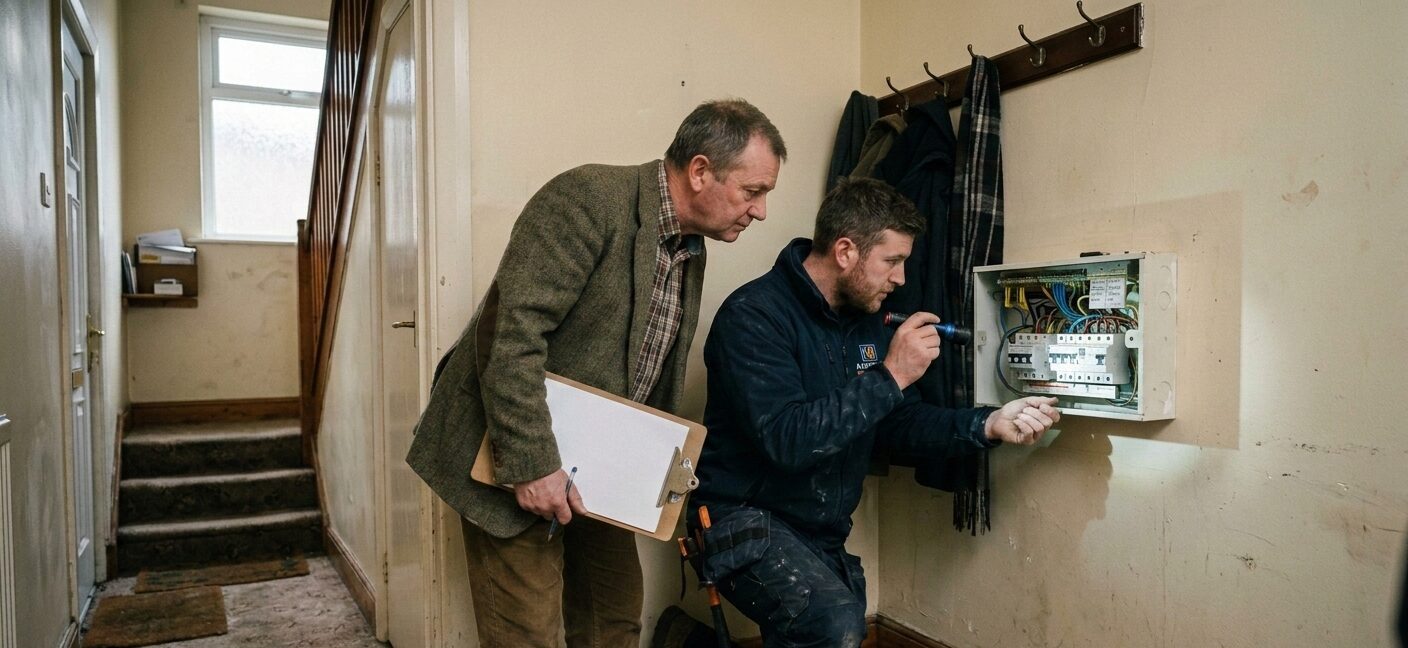
| THE DECEMBER 2025 DEADLINE HAS PASSED
Every private tenancy in Northern Ireland was required to have a valid EICR in place by 1 December 2025. If your property does not have a current report, you are already in breach of The Electrical Safety Standards for Private Tenancies Regulations (Northern Ireland) 2024. Local council enforcement officers can require you to produce your EICR within seven days. The maximum penalty is a Level 5 fine. Read this guide — then act. |
Northern Ireland’s private rental sector has entered a new era of electrical safety accountability. The Electrical Safety Standards for Private Tenancies Regulations (Northern Ireland) 2024 — made under Section 10 of the Private Tenancies Act (Northern Ireland) 2022 — require every landlord to have a qualified electrician inspect and test their property’s fixed electrical installation at least once every five years.
For new tenancies, compliance was required from 1 April 2025. For all existing tenancies, the deadline was 1 December 2025. Both deadlines have now passed. This guide explains exactly what the regulations require, what an EICR involves in practice, what to do if your report identifies problems, and what the consequences of non-compliance are.
What Is an EICR?
An Electrical Installation Condition Report (EICR) — sometimes called an electrical safety certificate or periodic inspection report — is a formal assessment of the fixed electrical installation within a property. It is carried out by a qualified person and tests and inspects everything on the consumer’s side of the electricity supply meter: the wiring, consumer unit (fuse box), sockets, light fittings, switches, and all other hardwired electrical equipment.
The purpose is to determine whether the electrical installation is in a satisfactory condition for continued safe use — not to certify that the property meets a brand-new installation standard, but to confirm it is safe as it stands. The report identifies any defects, deterioration, damage or non-compliances, codes them by severity, and recommends the interval before the next inspection.
| Q: What does an EICR actually test and inspect?
A: An EICR covers all fixed electrical cables and equipment on the consumer’s side of the electricity supply meter. This includes: the consumer unit (fuse box) and its protective devices; all fixed wiring throughout the property; socket outlets, light switches and lighting circuits; the earthing and bonding arrangements; fixed electrical equipment such as showers, extractor fans and electric heaters. Portable appliances and white goods are not covered by the EICR — they fall under PAT testing, which is a separate, currently non-mandatory process for Northern Ireland residential landlords. |
| Q: Is an EICR the same as an electrical safety certificate in Northern Ireland?
A: The terminology is sometimes used interchangeably but there are important distinctions. An EICR (Electrical Installation Condition Report) is an in-service inspection and test of an existing installation. An EIC (Electrical Installation Certificate) is issued for a new installation or complete rewire and certifies that the work meets the current edition of BS 7671. An MEIWC (Minor Electrical Installation Works Certificate) covers small-scale additions or alterations. For the purposes of the Electrical Safety Standards for Private Tenancies Regulations (NI) 2024, an EIC for a newly built or completely rewired property is accepted as the equivalent of an EICR. Your letting agent or electrician can confirm which document type is appropriate for your property. |
| Q: How much does an EICR cost for a Northern Ireland rental property?
A: The Department for Communities estimates the average cost of an EICR at approximately £200 per property for a standard five-yearly inspection. Actual costs vary depending on property size, age, the complexity of the electrical installation and the electrician’s rates. The regulations are clear that the cost of the EICR — and the cost of any remedial work the report identifies — must not be passed on to the tenant. These are landlord costs. Comparing multiple quotes from NICEIC or NAPIT-registered electricians is recommended. |
The Legal Framework: What the Regulations Require
| Requirement | Detail |
|---|---|
| Regulation | The Electrical Safety Standards for Private Tenancies Regulations (Northern Ireland) 2024 — NISR 2024/201 |
| Parent legislation | Section 10 of the Private Tenancies Act (Northern Ireland) 2022 |
| New tenancies — in force from | 1 April 2025: inspection required before or at start of every new tenancy |
| Existing tenancies — deadline | 1 December 2025: all existing tenancies must have had an inspection by this date |
| Inspection frequency | At least every 5 years — or more frequently if the EICR itself specifies a shorter interval |
| Standard | The 18th Edition of BS 7671 (IET Wiring Regulations) is the reference standard |
| Who can carry out an EICR | A qualified person — defined as someone competent to undertake the inspection under BS 7671. In practice: a registered electrician (NICEIC, NAPIT or equivalent) |
| HMOs | Houses in Multiple Occupation continue to be covered under the HMO Licensing Scheme and are not subject to these regulations |
| Enforcement | District councils — can serve remedial notices, arrange remedial action, issue fixed penalty notices or prosecute |
| Maximum penalty | Level 5 fine (currently uncapped in Northern Ireland for the most serious regulatory offences) |
| ONGOING DUTY — NOT JUST A ONE-OFF INSPECTION
The regulations impose a continuing duty, not a one-time compliance event. A landlord must ensure electrical safety standards are met throughout the entire period of the tenancy — not just at the point of the inspection. If a tenant notifies the landlord of an electrical fault at any point during the five-year interval, the landlord must arrange for a qualified person to assess and resolve it. Evidence of prompt action in response to reported faults should be retained. |
What Happens After the Inspection: Understanding the Results
The EICR will conclude with an overall condition assessment — either Satisfactory or Unsatisfactory — and will list individual observations coded by severity. Understanding these codes is essential for knowing what action you must take, and how urgently.
| Code | Meaning | Required Action | Timeline |
|---|---|---|---|
| Satisfactory | No code issues. Installation is in a safe condition for continued use. | None immediately. Note the recommended re-inspection date. | N/A |
| C1 | Danger present — risk of injury exists in the current state. | Urgent action required. Remedial work should be completed before or immediately after occupation. Do not let the property in this condition. | Immediate |
| C2 | Potentially dangerous — not an immediate danger but risk exists. | Urgent remedial work required as soon as practicable. The report is classified as Unsatisfactory until resolved. | As soon as practicable |
| C3 | Improvement recommended — not a compliance failure. | Not required for regulatory compliance. However, acting on C3 observations is good practice and reduces the risk of future C1 or C2 findings. | Landlord’s discretion |
| FI | Further investigation required — compliance cannot be determined without additional investigation. | Investigation is required. The report is classified as Unsatisfactory until resolved. | As soon as practicable |
| Q: My EICR came back as Unsatisfactory. What do I need to do?
A: An Unsatisfactory EICR means the report has identified C1, C2 or FI observations that require action. You must arrange for a qualified person to carry out the necessary remedial or investigative work. Once completed, you must provide the tenant with written confirmation that the work has been done, and supply a copy to your local council within 28 days of completion. A follow-up inspection or certificate confirming the remedial work is complete should be attached to the original EICR as a permanent record. Depending on the severity of the finding, you may need to pause the tenancy or delay new occupation until the work is done. |
| Q: An older property has wiring installed under a previous edition of BS 7671. Does it automatically fail?
A: Not necessarily. The Department for Communities guidance is explicit on this point: existing installations installed to earlier editions of BS 7671:2018 may not comply with the current 18th Edition in every respect, but this does not automatically mean they are unsafe for continued use or require upgrading. The EICR assesses the in-service condition of the installation against the current standard and identifies any departures that constitute a danger or potential danger. An installation can be Satisfactory even if it pre-dates the current standard, provided it is safe for continued use. |
EICR Documentation Duties: What You Must Provide and When
Obtaining the EICR is only part of the obligation. The regulations also impose specific duties about how and when the report must be shared.
| Document / Action | Recipient | Deadline |
|---|---|---|
| Copy of the EICR | Existing tenant(s) | Within 28 days of the inspection being carried out |
| Copy of the EICR | New tenant | Before they occupy the premises |
| Copy of the EICR | Prospective tenant | Within 28 days of receiving a written request |
| Copy of the EICR | Local council (if requested) | Within 7 days of receiving the request |
| Written confirmation of remedial work completed | Tenant | Within 28 days of completing the remedial work |
| Written confirmation of remedial work completed | Local council (if requested) | Within 28 days of completing the remedial work |
| EICR retained until next inspection due | Landlord / agent to hold | Ongoing — must be provided to the electrician carrying out the next inspection |
| SEVEN DAYS — THE COUNCIL DEADLINE
If your local council enforcement officer requests a copy of your EICR, you have only seven days to provide it. This is not a long window. Every landlord — and every managing agent — should know exactly where their EICR is and be able to produce it immediately on request. Belvoir NI stores EICR documentation for all managed properties as part of the property record. |
Choosing a Qualified Inspector
The regulations require the inspection and testing to be carried out by a “qualified person” — defined as someone competent to undertake the inspection under the requirements of BS 7671 and any relevant investigative or remedial work in accordance with electrical safety standards.
In practice, the Department for Communities and Electrical Safety First both recommend using an electrician or firm registered with a recognised electrical trade body. The two primary bodies for Northern Ireland are NICEIC (National Inspection Council for Electrical Installation Contracting) and NAPIT (National Association of Professional Inspectors and Testers). Both maintain public registers of qualified, insured electricians who can be searched by postcode.
| Q: Can I use any electrician for an EICR or does it have to be a specialist?
A: The electrician must be a “qualified person” under the regulations — someone competent to carry out an inspection and test under BS 7671. Not every general electrician will hold the specific inspection and testing qualification required. Using a NICEIC or NAPIT-registered inspector provides confidence that the electrician has been independently assessed as competent and that their work meets the required standard. Belvoir NI can recommend NICEIC-registered inspectors operating in your area if required. |
| Q: Can a tenant refuse access for an EICR inspection?
A: A landlord must take all reasonable steps to arrange and facilitate the inspection. If a tenant unreasonably refuses access, the landlord should document every attempt made in writing — date, method, evidence of the request and the tenant’s response. A landlord who can demonstrate genuine and reasonable efforts to gain access, documented thoroughly, has a defence against prosecution for non-compliance. However, a landlord who makes no effort to arrange an inspection cannot rely on this defence. Belvoir NI’s managed service includes coordinating and documenting access arrangements for all compliance inspections. |
Enforcement and Consequences of Non-Compliance
Enforcement of the EICR regulations rests with Northern Ireland’s 11 district councils. Authorised council officers have powers to issue remedial notices, arrange for remedial action to be taken at the landlord’s expense, issue fixed penalty notices, and initiate prosecution.
| WHAT COUNCILS CAN DO
If a council enforcement officer believes an offence has been committed under the Electrical Safety Standards for Private Tenancies Regulations (NI) 2024, they have two options: (1) Take the landlord to court for non-compliance — the maximum penalty is a Level 5 fine; or (2) Issue a fixed penalty notice. If the EICR shows the electrical standard has not been met, the council is required to serve a remedial notice. The landlord then has 28 days to complete the remedial work — or a shorter period if urgent hazards are identified. |
| Q: What is a Level 5 fine in Northern Ireland?
A: Northern Ireland uses the UK standard scale for criminal fines. A Level 5 fine is the highest category on the standard scale and is currently unlimited in amount for certain regulatory offences — meaning the court can impose whatever penalty it considers appropriate given the circumstances and the landlord’s financial position. For context, in England the maximum civil penalty for equivalent electrical safety breaches was increased to £40,000 in November 2025. While NI operates a different penalty framework, landlords should not treat non-compliance as a low-risk issue — enforcement action, reputational damage and civil claims from tenants all represent significant financial exposure. |
| Q: Does non-compliance with the EICR regulations affect my ability to serve a valid Notice to Quit?
A: This is an important practical consideration. While the Electrical Safety Standards Regulations do not directly prohibit service of a Notice to Quit in the way some housing legislation elsewhere does, a landlord who is clearly in breach of legal obligations may find their position weakened in any subsequent court proceedings — including possession proceedings. More practically, evidence of systemic non-compliance with safety regulations is likely to inform a council enforcement officer’s appetite for further action against that landlord. Maintaining compliance across all obligations is the surest protection. |
EICR Compliance Checklist for NI Landlords
| Action | Status Check |
|---|---|
| EICR carried out by a qualified (NICEIC or NAPIT-registered) inspector | Do you have the original report? |
| EICR result: Satisfactory, or Unsatisfactory with all C1/C2/FI observations remediated | If Unsatisfactory — has all remedial work been completed and documented? |
| Copy of EICR provided to each current tenant within 28 days of inspection | Do you have a record (email, signed acknowledgement) of delivery? |
| Copy of EICR ready to provide to any prospective tenant within 28 days of request | Is the report easily accessible to your letting agent? |
| Copy of EICR ready to provide to local council within 7 days if requested | Is it stored in a retrievable format by your managing agent? |
| Written confirmation of remedial work provided to tenant and council if applicable | Has the completion confirmation been filed with the EICR? |
| Next inspection date noted (typically 5 years from inspection date, or earlier if specified) | Is this diarised with your managing agent? |
| Response process in place for tenant-reported electrical faults during the tenancy | Does your managing agent have a clear protocol for this? |
| BELVOIR NI MANAGED LANDLORDS
If Belvoir Northern Ireland manages your property, all of the above is handled as part of your management service — from arranging EICR inspections with NICEIC-registered electricians, to storing documentation, to issuing copies to tenants and coordinating remedial work. If you are self-managing and have not yet obtained your EICR, contact Belvoir NI now. |
| Need an EICR for Your Northern Ireland Rental? Belvoir NI Can Help.
The December 2025 deadline has passed. If your property does not have a valid EICR, you are currently in breach of the regulations. Belvoir NI can arrange an EICR inspection through our network of NICEIC-registered electricians and manage the whole process — documentation, tenant communication and follow-up if remedial work is required. → Contact your nearest Belvoir Northern Ireland office today |
Belvoir Northern Ireland | belvoir.co.uk/northern-ireland
Belvoir Group — UK’s Largest Property Franchise | ARLA Propertymark Protected | Client Money Protection
Information correct as of February 2026. Legislative reference: The Electrical Safety Standards for Private Tenancies Regulations (Northern Ireland) 2024 (NISR 2024/201). Parent legislation: Section 10, Private Tenancies Act (Northern Ireland) 2022. Guidance: Department for Communities, communities-ni.gov.uk. This guide is for general information only and does not constitute legal advice.